
'It is a fiercely fought battle, like our fiery chillies in Guntur.'

'Because the economics of the Food Security Bill is not viable, poor people are not going to get it. Poor people are going to take it and sell it in the open market. How does migrant labour store rice securely,' asks RS Seshadri, an agro industry expert

Aiming to push India into the list of the top 10 agri export nations, the policy has been backed by the Prime Minister's Office
In a research note, Standard Chartered Bank said continuing concerns over exportable surpluses should keep rice prices above $20 per quintal for most of the year. Among the concerns are export restrictions that could potentially increase inflationary pressures in importing countries that have few substitutes for rice. When the new crop arrives from Thailand it will exert downward pressure on prices.
In a big threat to Indian exports, Russia has warned India that it will ban imports of rice, sesame and peanuts if New Delhi fails to comply with food safety requirements.

In his monthly Mann Ki Baat radio broadcast, Modi hailed the potential of India and said the basis of its strength is the country's farmers, artisans, weavers, engineers, small entrepreneurs, the MSME sector and people from many different professions."
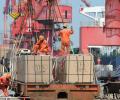
Imports too declined 26 per cent to $29.47 billion in August, leaving a trade deficit of $6.77 billion.
Pakistan is planning to take legal action against the Indian government for illegally announcing Super Basmati rice as an Indian product.
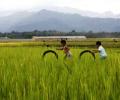
In urban India, the fall in rice consumption was 0.2 kg per person per month.
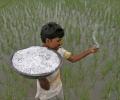
Chhattisgarh, popularly known as the rice bowl of central India, is witnessing politics over the foodgrain with ruling the Bharatiya Janata Party and main opposition the Congress trying to attract voters through it.

ITC's results for the January-March quarter (Q4) were strong, with robust growth in the fast-moving consumer goods (FMCG) segment and a good performance in hospitality. The tobacco division's performance was on expected lines, with double-digit volume growth, helped by reclaiming of market share from the smuggled trade. There was 60 per cent growth in non-cigarette earnings before interest and tax (Ebit), despite a relatively weak performance in paperboards.

The southwest monsoon has started on a weak note and this has delayed the sowing of kharif crops. Though a cause for concern, the situation hasn't reached a stage where it warrants any panic response. Moreover, according to meteorologists and industry players, monsoon rains will witness a revival in the coming few weeks.

The Russia-Ukraine crisis, along with general bullishness in agricultural commodities, has ensured that after a fairly long time, most of the 24 commodities for which the Centre declares the minimum support price (MSP) are trading above it. The exceptions here are chana or gram and a few varieties of pulses. This might gladden the farmers, especially those who are still holding on to their stocks from the previous kharif harvest or are harvesting the latest rabi crop. But this could stoke retail and wholesale inflation.
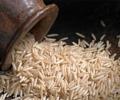
The industry expects Iran to purchase at least 1 million tonnes this financial year
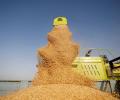
The government on September 14 further reduced the stock limit on wheat traders, wholesalers and big chain retailers to 2,000 tonnes from 3,000 tonnes with immediate effect to control wheat prices, which are showing an uptick again after being stable for some time. Announcing the move, food secretary Sanjeev Chopra said that retail prices of key essential food items, especially wheat, rice, sugar, and edible oils, were unlikely to see any sharp rise in the upcoming festival season as the country had adequate supply and the government was keeping a close vigil on hoarders.

'There are occasions when the prices of individual items like food raise inflation; then supply-side measures must be taken.' 'But if there is continued inflation, it means liquidity is aggravating the situation.'
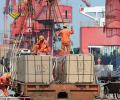
Import segments which recorded negative growth include gold, silver, transport equipment, coal, fertiliser, machinery and machine tools. However, exports of oil seeds, coffee, rice, tobacco, spices, pharma, and chemicals reported positive growth in June.
Pakistan has evinced interest to buy 500,000 tonne Indian rice later this year for re-export to other countries.\n\n\n\n
India is heading for a major rise in food prices especially rice and pulses. Following the global trend and anticipating a shortage, Central government has raised the minimum price for non-Basmati rice exports. Other countries like Egypt and Cambodia have imposed restrictions on export of rice. With rice being staple food in many countries export restrictions will affect prices in the importing countries. These countries are already facing social unrest over high food prices.

The International Monetary Fund (IMF) warned on Tuesday that India's general government debt (comprising both central and state government debt) could exceed 100 per cent of gross domestic product (GDP) in the medium term. It also cautioned that long-term debt sustainability risks are high due to the significant investment required to meet India's climate change mitigation targets. The Indian government, however, disagreed, arguing that risks from sovereign debt are extremely limited as it is predominantly denominated in domestic currency.

If states have to fall in line with MSPs declared by political parties, they will have to do so in violation of central order or bear the full expense of the surplus procured at above MSP rates.
China has clinched deals to sell more milling wheat and rice, helped by logistical logjams in India that have delayed delivery to ports of its subsidised grain for export, traders said on Wednesday.

After recording positive growth in September, India's exports declined 5.4 per cent to $24.82 billion in October on account of dip in shipments of petroleum products, gems and jewellery, leather, and engineering goods. Trade deficit in October narrowed to $8.78 billion as against $11.76 billion, as imports also fell 11.56 per cent to $33.6 billion during the month under review.

If it continues to do well economically, develops a large manufacturing sector, gains in technological heft, builds a more capable defence industry, improves its human development indicators, becomes more of a trading nation, and has greater internal cohesion. In short, it is a work in progress, suggests T N Ninan.
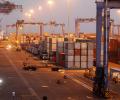
Growing for the third consecutive month, the country's exports rose marginally by 0.67 per cent year-on-year to $27.93 billion in February even as trade deficit widened to $12.62 billion, according to official data released on Monday.
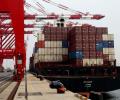
Imports too declined by 16.31 per cent to $37.39 billion.

Livestock auctions remained on hold for the majority of the lockdown as there was no clarity on the matter.

Sectors with positive growth during the month include rice, iron ore, oil seeds, oil meals, meat, dairy and poultry products, pharmaceuticals, coffee, engineering goods, and plastic.

Iran is India's largest importer of tea in value terms while in terms of volume, it is the second largest after Russia
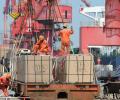
Trade deficit during the month narrowed to USD 14.54 billion from USD 15.3 billion in January 2020. It was USD 15.44 billion in December 2020.

The rail ministry's proposal to reduce transportation tariff for foodgrain by Rs 100 per wagon would not have any cooling effect on food inflation, which was close to 18 per cent for the week ended February 6.

After contracting for six straight months, India's exports rose 5.99 per cent to $27.58 billion in September on account of growth in shipments of drugs and pharmaceuticals and readymade garments, as per the government data released on Thursday. Exports stood at $26.02 billion in September 2019. The country's imports contracted 19.6 per cent to $30.31 billion in September.
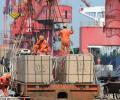
India's exports fell for the fourth straight month in June as shipments of key segments like petroleum and textiles declined but the country's trade turned surplus for the first time in 18 years as imports dropped by a steeper 47.59 per cent.
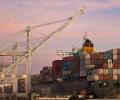
The country's exports dipped 8.74 per cent to $23.52 billion in November on account of contraction in shipments of key sectors like petroleum, engineering, chemicals and gems and jewellery, official data showed on Tuesday. Trade deficit during the month narrowed to $9.87 billion as imports too declined by 13.32 per cent to $33.39 billion.
According to USDA estimates, the US accounted for an average of 11.5 percent of world exports of rice for calendar years 2004 through 2007 and is projected at 12.7 percent for 2008. US exports will increase to 3.5 million metric tons while world total exports decline to 27.5 MMT. The largest rice exporter is Thailand at 9.0 MMT for 2007/08, 32.7 percent of world exports, down 0.5 MMT from 2006/07 and up from 7.3 MMT in 2004/05 and 2005/06.
The main focus of US Secretary of State Condoleezza Rice's talks in New Delhi will be the increasingly cordial Indo-US relations.

The country's exports grew 5.37 per cent year-on-year to $27.24 billion in January 2021, mainly driven by healthy growth in pharma and engineering sectors, according to provisional data of the commerce ministry. Trade deficit during the month narrowed to $14.75 billion from $15.3 billion in January 2020. It was $15.44 billion in December 2020. Imports in January 2021 rose 2 per cent to $42 billion.

'The karyakartas who wanted to contest were disappointed and it took some time to explain to them why we needed an alliance.'
Catastrophic flooding and crop losses in Thailand - the world's leading rice exporter - are raising concerns that another food crisis may be in the offing.
 © 2026 Rediff.com - Advertise with us - Disclaimer - Privacy Policy - Sitemap - Feedback - About us - Terms of use - Grievances